“The illusion of comprehension arises because people confuse understanding with familiarity or recognition”
Complexity abounds and to make it even more complicated we frequently don’t know what we don’t know. We draw conclusions about the world based on small glimpses and yet many people call themselves experts on subjects they only grasp superficially, creating an illusion for themselves and for the ones they influence.
As Steven Solman, cognitive scientist says, “We are fashioning a dangerous society where everyone with a smartphone is an expert”. If people understood the dangers of this, perhaps our society will be more critical, less polarized and the advancement of knowledge, powered by collective intelligence, will allow us to move forward in a faster pace.
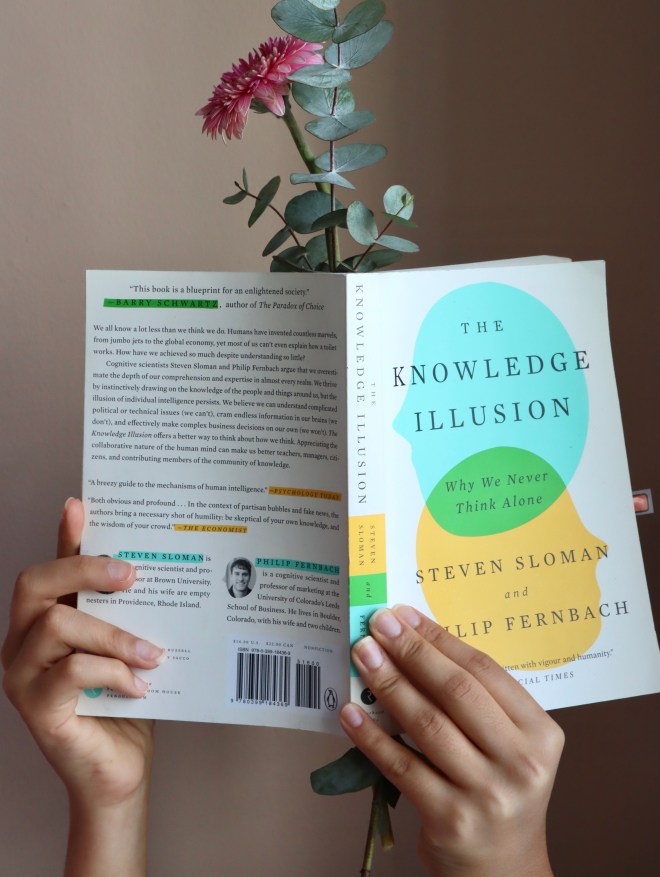
These ideas are presented in the book ‘The Knowledge Illusion’ written by cognitive scientist Steven Solman and Philip Fernbach, and that I recently had the opportunity to read. The book has three central themes: ignorance, the illusion of understanding and the community of knowledge. In this review I will share a couple of notes and reflections I wrote while reading it. I warned you, that you might end you with more questions than answers.
Complexity and intentionality
The authors argue that we tolerate complexity by failing to recognize it. That’s the illusion of understanding. However, this idea also raises the question of how can humanity achieve so much when people are so ignorant? The answer might not surprise you, especially in the connected world we live in: collective intelligence “When multiple cognitive systems work together, group intelligence can emerge that goes beyond what each individual is capable of”, this means sharing intentionality (philosophical concept defined as “the power of minds to be about, to represent, or to stand for, things, properties and states of affairs”), in other words to share a common ground on how things should be and why, moreover: what do we want to achieve.
This made me reflect on corporate culture and why over the last decade it has become more important to build a strong ‘corporate culture’, as the working environment evolves from industrial labor to cognitive labor plus the amount of information and data available make it more complex and demand a more qualify and ‘smart’ workforce, the authors defines smart as someone “having the ability to extract deeper, more abstract information from the flood of data that comes into our senses”.
Sharing intentionality is all about the ability to store and transmit knowledge, form one person to another but also from one generation to the next. This off course is possible through communication via language.
Language and storytelling
If you think about it, language is what allow us to make sense of the world it defines the way we think and our mental structures. Language also allow us to tell stories, something that I am particularly passionate about and had researched. We use stories all the time, to construct our identity but also to construct an idea of the people around us, is our tool to connect with the world. “Storytelling perhaps is the most common way that people pass causal information to one another”.
Storytelling don’t only help us to make sense of the past but also helps us imagine how the world would be if something were different, and every time are in the process of making a decision we do so by creating alternatives worlds in our heads and telling our self stories of the possible outcomes.
In science fiction is clearer, we talk about alternative worlds. I will not go deeper into this as the authors just mention it a couple of times during the book but if you are interested you can read about Narrative Transportation theory and World Building theory to become aware of the science behind it.
Going back to the book, “the illusion, why we think we know more than we actually do is a product of the intuitive mind” in other words “we draw conclusions about the world based on small glimpses”, the problem is that because we are living in a community of knowledge “we fail to distinguish the knowledge that is in our heads from the knowledge outside of it”.
Community thinking
In the bright side, community thinking helps us transform individual ideas into great creative spirit that during times have even changed popular culture (e.g. The Beatles), ideas that emerged from their interaction, from their conversations, not from their individual contributions.
“Science seems to make progress not just because a genius come along, but also because conditions are right for discoveries. […] Most important, the right conversations are already happening […] Significant success requires more than individual intelligence”, reading between the lines this means that teamwork is important, but the team have to be active, bringing new things to the table, triggering the right conversations, disagreeing when is necessary and creating the conditions for the innovation and good ideas to flourish.
Another important element to ‘shatter the illusion’ is diversity: “When people like minds discuss an issue together, they become more polarized”, this is also discuss in Harari’s book 21 Lessons for the 21st Century when he says that people are rarely aware of their ignorance, because they locked up in a soundproof room of friends who harbor similar ideas and news that confirm themselves, where their beliefs are reinforced and rarely questioned. “Unfortunately, Citizens, commentators, and politicians frequently take a stand before engaging in serious analysis”.
Becoming aware of our ignorance and doing something about it
Exposing people illusions can upset them. Admitting we are ‘ignorant’ on certain things is a strength, it should be a mindset that motivates people to be more analytical when making choices and more critical when it comes to the sources they get their information from. And more over have the responsibility to learn about our own ignorance and effectively take advantage of other knowledge and skills.
Finally, the authors reflect on how learning what you don’t know is about asking why, and emphasizes that “learning your place in the community of knowledge requires becoming aware of the knowledge outside yourself, what you don’t know that touched on what you do know”.
Shattering the illusion is hard and complex, but is the only way to move forward, to grow personally and professionally. Being aware of our ignorance among many things and start doing something about it.
This reading is a good start, for example.
#iread
 Las Notas de Ivanna